
It is considered to be the oldest illustration of the starry sky from the Early Bronze Age (Meller 2002) Citation: ‘Die besondere Bedeutung der Himmelsscheibe von Nebra liegt in der bislang wohl weltweit ältesten konkreten Abbildung des Sternenhimmels mit der Darstellung komplexe astronomischer Phänomene’ (The special significance of the celestial disc from Nebra lies in probably the oldest particular depiction of the starry sky in the world with the depiction of complex astronomical phenomena).This view is not unequivocally accepted and attempts to interpret the meaning of the Nebra disc to continue to the present. Some authors find it a shamanic instrument (Pasztor and Roslund 2007), or an image of the sky during a solar eclipse to explain the position of all depicted subjects (Kaulins 2000). Furthermore, the Nebra disc, like the Neolithic Goseck, could be a record of a solar year, but not a lunar one (Koch 2007), an indicator of solstice positions in distant landscape perspective from the site of the finding location according to a virtual 3D model (Buhmann et al. 2005). Another approaches are morphometric analysis with a particular conclusion: it is more of a calendar, but also a possible plan of the environment for descendants (Dathe and Krüger 2018), according to archaeological and content – style analysis, its origin should be researched in the Iron Age (Gebhard and Krause 2020).
The author used his original thinking from the analysis of cup-marked stones, where he does not look at the Nebra disc as an image (possible sky) laid or hung, but as an Moon symbol placed under the ceiling (?) and oriented according to the cardinal points. The circular targets lack a hint that there would be stars; the indicative schematics of the entire depiction, together with the crescent of M. and the full moon, indicates a relationship to the lunar symbolism. The author also questioned whether the 7 targets represented the Pleiades. They oppose the solar barge (in the east), so he, in this thinking, thought of them as the west or the moonless, dark night (winter constellation). 40 perforations around the perimeter could indicate that it was placed (perhaps sewn) under the ceiling of the monopter (circular shrine, etc.), to be viewed from below, in the sense of its own synonym ‘celestial disc’.

Practical model of Nebra disc
The shape changes of M. became the basis of extensive M. mythology, e.g. (Eliade 1949). It follows the entire history of humanity, and therefore the author researched which of the cyclical changes of M. could be recorded graphically by a non-literary society. It could be where M. appears after dark, from where it rises on the horizon, when or where it reaches the peak, how much light can be expected, and all this with a whole (28–30) or reduced (12–14) nights. For the information to be understandable, it must be oriented along the NS axis, which is the same in the sky for a sunny day or a clear night. To find the geographical directions in the Nebra disc (similar to the analysis of cup-marked stones) it was necessary to rotate the disk correctly (Figure 6). The upper picture on the left is the finding situation: the sun barge is at the lower edge, the crescent moon on the right. If we turn it 90° to the right (second picture on the right) and figuratively lift it above the head, about as the disc was presented (third picture below), then for us the position of S. barge located in the east or the Pleiades on the west side will not change. The full moon turns ‘in front of us’ and the crescent ‘behind us’. This completed the orientation to the sides of the world: the full moon is now in the north, crescent in the south. The idea can be completed by looking at the transparent disc and placing it in front of us. All the graphic elements remained in place as if viewed from below.
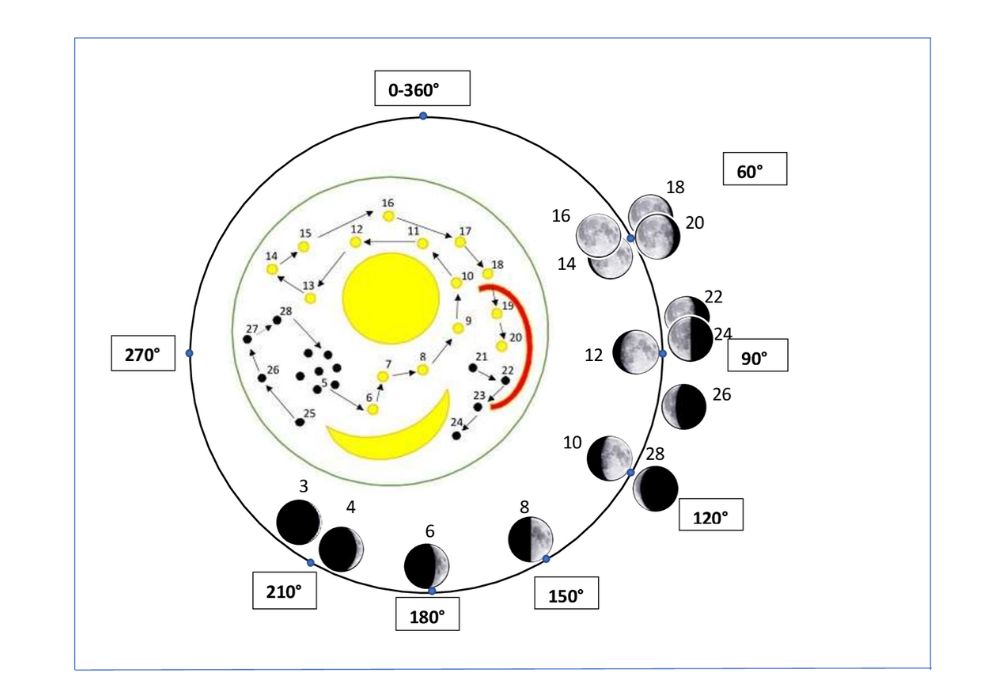
Analysis of Moon dawns in relation to cardinal points
In the next step, the theoretical circular model of the M. cycle was compared, ie the position of the expected direction of occurrence of M. in the evening, winter sky after dark with the distribution of targets of the practical model of the N. disc. The lunar calendar can begin at any stage of the M. cycle – with the first crescent, it began anew, for example, in Mesopotamia, the same applies to the current Islamic lunar calendar. The author did not rule out the possibility that the Nebra disc could be of Celtic origin from the Iron Age (Gebhard and Krause 2020) Citation: ‘Far more, if the origin from the Mittelberg could be confirmed, a dating also within the context of the Iron Age fortification as well as in the iconography would be obvious.’
It was based on a communication by Pliny the Elder (Perseus Digital Library n.d.) who writes in Naturalis historia about the date of the religious ceremony for mistletoe collecting performed by druids… et ante omnia sexta luna quae principia mensum annorumque bis facit… which is, as a rule, the sixth night which is the beginning of their months and years … this is done more especially on the fifth day of the moon. Further also with his description of the moon (Luna) and why it was chosen … quia iam virium abunde habeat nec sit sui dimitia… this day they select because the moon though not yet in the middle of her course, has already considerable power and influence. The characteristic of Moon then ends … Omnia sanantem appellant suo vocabulo … and they call her by a name which signifies, in their language, the all-healing. In addition to the extraordinary importance that the Celts put to the Moon, it is essential that the crescent at the south pole of the Nebra disc model (Figure 7) corresponds to Pliny’s sixth night as the beginning of the month. It is then defined as the rising crescent–Waxing Crescent Moon illuminated by 30%. Targets continue to rise from M. crescent along east to north, nights 14–16–18 are a week around the full moon, from the 22nd night according to the (calendar from Coligny; Wikipedia, “Coligny Calender”)begins the restoration of nights (atenoux). ‘Bright’ nights in the N. disc changes to ‘dark’, they are color-coded in the model. The Pleiades (7 targets) are now losing their unequivocal astronomical position as a constellation more like the west… it’s 7 targets, but are they really the Pleiades? It is therefore possible to evaluate nights according to the distribution of targets and the theoretical model from 6 to 21 thus, nights can be considered ‘bright’ (in the table of columns b, i, j, rows 6-20), when the area of the illuminated M. ranges from 40% to 100 % and further decreases to 80%. From the 22nd night Moon appears before midnight and the moonlight move to the morning (in the table of columns b, i, j lines 22–28) atenoux begins, restoration of the nights: M. continues to back, reaching the meridian only above the morning, while in nova, will completely disappear.
Nebra disc as a lunar calendar
The theoretical model supports graphics in the Nebra disc model– both symbolically correspond to the calendar from Coligny, which divides the month into light and dark parts after 15 days and thus does not exclude the possible Celtic origin of the Nebra disc. The analysis also allows further thinking: 1, The Nebra disc is not the oldest depiction of the starry sky but a lunar calendar from the Early Bronze Age. Its age would correspond to Phase III of the construction of (Wikipedia, “Stonehenge 3 IV”)andthen it would be possible (2280 –1930 thousand BC) that the use of the lunar cycle / lunar calendar and the counting of nights was already practiced in Europe (England) in the Earlier Bronze Age (2. thousand BC), i.e., about 15 centuries before Pliny noticed it. 2, If we accept the critique of the origin of the Nebra disc from the Early Bronze Age and the possible dating to the Iron Age, it could also be a Celtic lunar calendar from the La Tène period (from the 5th century BC). The basic unit of the Celtic calendar was the 15–night interval; the light first half always had 15 nights, the second dark half was 14 or 15(Coligny calendar). From this point of view, the golden arcs lining the south and north (missing) poles of the topographically oriented N. disc would be made to emphasize the division of the N. disk (= lunar calendar) into the light (northern) and dark (southern) halves of the month.