
If we date the origin of cup-marked stones into the Eneolithic, there is a question about the significance and age of other stones in the immediate vicinity (1 m) from Heiliger Stein. Their shape and the dark gray color with signs of weathering contrasts with the light stone granite surroundings and resemble the round basalt balls found so far in the quarry in Pauliberg (Burgenland, Austria, topographically 47.5846150N, 16.3429567E). These are 12 round basalt stones half sunk into the ground, lined up further to the south (Fig. 5.). The first six in a row with a diameter of up to 50 cm at half-meter intervals are finished by a circle of five other stones. The last is at a distance of 10 m, located at 15° SW.
Mineralogical analysis of a sample of basalt from Heiliger Stein and basalt mined in Pauliberg (Burgenland, Austria) performed by Mgr. Dalibor Všianský, Ph. D from the Faculty of Science of Masaryk University in Brno, proved that this is not only the similarity of shapes. The chemical composition of both samples is identical according to EDX analyses on the sections; according to the normative composition of basalts in the TAS diagram, the samples correspond to tephrit/trachybasalt. Citation: “The differences between the samples correspond to a higher and lower proportion of porphyric outgrowths. Otherwise, there is an exact match. Most likely, therefore, these are samples from the same source locality ” (a complete mineralogical analysis is with the author).
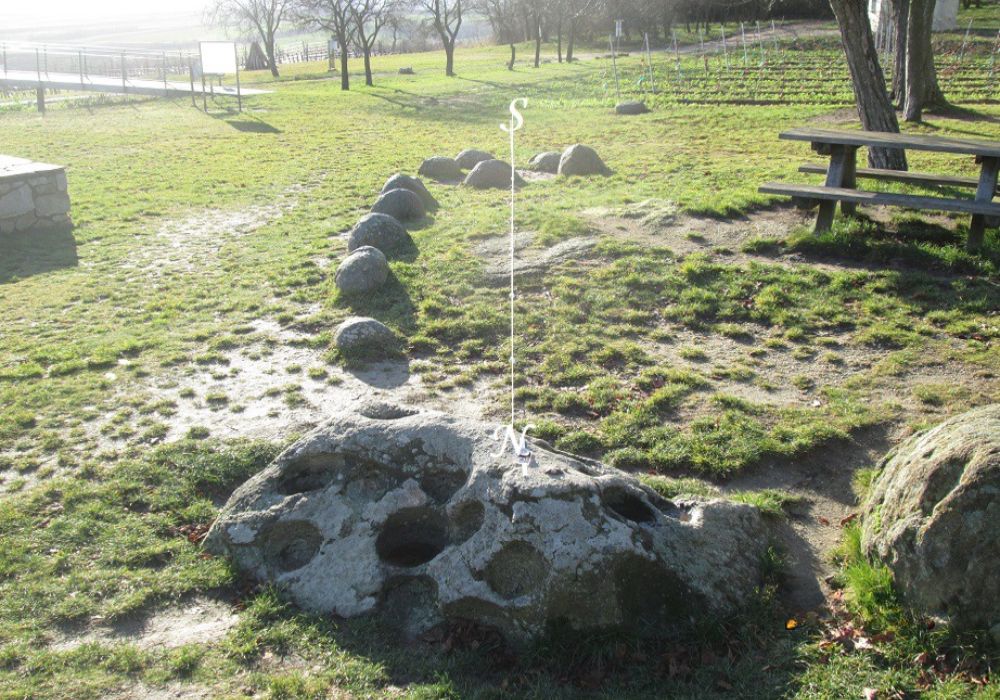
Analysis of the distribution of 12 basalt stones
Do basalt stones relate to the (Eneolithic) lunar symbolism of Heiliger Stein? The author explains the importance of their location and positioning in 3 steps. He origins from a table in which the azimuths of the M. Dawns are for the cycle 11/12/2022 after the onset of nautical twilight at 5 pm [column. d, e].
1.) 4-6 nights M. appears between 201 ° -175 ° (low above the horizon 11-22 °) and on the sixth night, it ascends to the meridian for the first time (at 5:19 pm). This was for the Celts, according to Plin sn. (Plin. Nat. 16.95) the first night of the lunar calendar.
2.) Until the 16th night, its position depends on dusk [row 8-16, column e] because M. appears from 11:32 am to 4:35 pm, i.e., in daylight.
3.) Only on the 18th night [row18, column d] M. appears on the horizon in the geographic east. However, even in the second half of the cycle, the places of dawns visible on the horizon are not the same; they move 18° to the south every two days. If the 18th night [row 18, column c, d] M. starts at 50°, 28th night [row 28, column c, d] it will be 123°, (+ 73°). Only the position of Moon does not change when crossing the meridian when it culminates above south. (180°). Thus, according to the above-defined topographic dawns of M., the basalt stones are also positioned:
1.) the sixth night, when Moon has the character of a crescent, which was initially the start of the Celtic lunar calendar, corresponds to the position 10 m away from the SW located stone,
2.) as for the next ten nights Moon comes out on the horizon during the day it makes sense to mark its evening position (given by dusk) localize as a circle of 5 stones (8-16 nights).
3,) From the 18th night, it is possible to observe the dawns of Moon the horizon, its position shifts to the south every night; therefore, it is easiest to record only its transitions through the meridian (i.e., south) of six stones in a meridian arrangement from south to north (18-28 night) where the Heiliger Stein cup-marked stone is located. From the analysis, it can be concluded that the arrangement of 12 basalt stones at Heiliger Stein has the character of a Celtic record of the M. cycle beginning on the 6th night after the nova phase, divided into light (circle of stones) and a dark part (line of stones).
Archaeological excursion to the La Tène
Apart from the unique Celtic finds, there was no more such a similar culture in the Znojemsko region that could be attributed to this symbol of the lunar cycle. The transport of basalt stones from Pauliberg to Mitteretzbach (distance of 180 km) evokes a strong culture and mythology and cooperating families or clans, contrasting with the absence of a significant Celtic settlement. (Podborský 1988, 136) Citation: “Remarkably, there are no La Tène finds known from the locality (Znojmo Castle). The period of the ancient Celts in southwestern Moravia is represented by only a relatively small number of their authentic remains”. Similarly, according to Šimek (Šimek 1950, map in p. 64) and Čižmářová (Čižmářová 2004), the late La Tène finds in the Znojemsko region are very few in comparison with the Bohemian-Moravian Highlands, Brno or Haná. The majority (104) of Moravian archeological sites lie to the east and north of Znojmo.
The culture that could have created this place of lunar cult can be found in the La Tène settlement of Lower Austria. Here, at a distance of 30-40 km from Heiliger Stein and the border crossing with the Czech Republic, Karl (Karl 1996, 41) provides an overview of 332 settlement finds from the La Tène A to C-D from the period from 450 BC to the almost the next century. (Lindermayer 2008, 46) mentions the La Tène oppidum on Sandberg, at the time of its great prosperity as a shopping center with 2,000 inhabitants and the oldest mint (distance Sandberg – Mitterretzbach is 17 km according to the map.cz), which was in contact with about 30 satellite settlements. It is located on more than 22 ha and the foundations of around 450 houses were found by magnetic prospecting. Retz has also been a well-known large housing estate since that period. There is a possibility that the Celts in this period rebuilt the originally Eneolithic cenotaph/dolmen into a lunar calendar within their mythology and thus established the cult tradition of Heiliger Stein. It is not rare for the Celts, in this case, the Buoys and Noriks (Karl 1996, 162), to often use Neolithic buildings to present their art (Celts 1967, 293):”Many illustrations of gods, snakes, etc. appear on Neolithic menhirs (pillars) and dolmens (stone tombs), which were therefore attributed to the Celts, but today it is believed that the Celts used them only secondarily.”
Another possibility (more probable) is that it was brought to Miterretzbach by the Celts themselves. The source of the stones is the volcanic mountain Pauliberg, in the distance of 20 km from Oberpullendorf. According to Schlinke (Schlinke 1988, 193-195), Oberpullendorf was an important center of iron production during the La Tène period with a production volume of around 50 tons per year. After layered mining of hematite, the remains of 20 000 mining pits and over 100 foundations of metallurgical furnaces were found in the area. Probably the prospectors had found unusual basalt rocks, which together with the exported iron transported to a new location. Perhaps this was how the Celtic sanctuary was created under the open sky, where a system of stones represented the cult image of the M. cycle. In addition to the lunar calendar, which began according to Pliny the Elder (16.115) , the sixth night after the nova, it was the rule for the Celts to count nights instead of days (C. Julius Caesar 6.18): lat.: spatia omis temporis non numero dierum, sed noctium finiunt, dies natales et mensum et annorum initia sic observant, ut noctem dies subsequatur, meaning sic noctem observant = observing tonight, ut subsequatur dies = the following day, English: they compute the divisions of every season, not by the number of days, but of nights; they keep birthdays and the beginnings of months and years in such an order that the day follows the night.
The life of the Celts was closely connected with lunar symbolism: Polybios (5,78,1) informs on a lunar eclipse during the war between King Attal I and Achaia, after which the Celtic soldiers refused to march on further. It was also part of the burial grounds: (Eliade, 1949, 158) here refers to Cumont 11: The burial symbol of the crescent is common throughout whole Europe (Cumont, 1942, 213), in Gaul (ibid., 217), where the Moon was the original symbol used long before contact with Romans. Therefore, in the researched stone system, it is challenging to decide what this (lunar) symbol was used for, whether it was intended for the M. cult or a funeral symbol.