
Archaeoastronomy
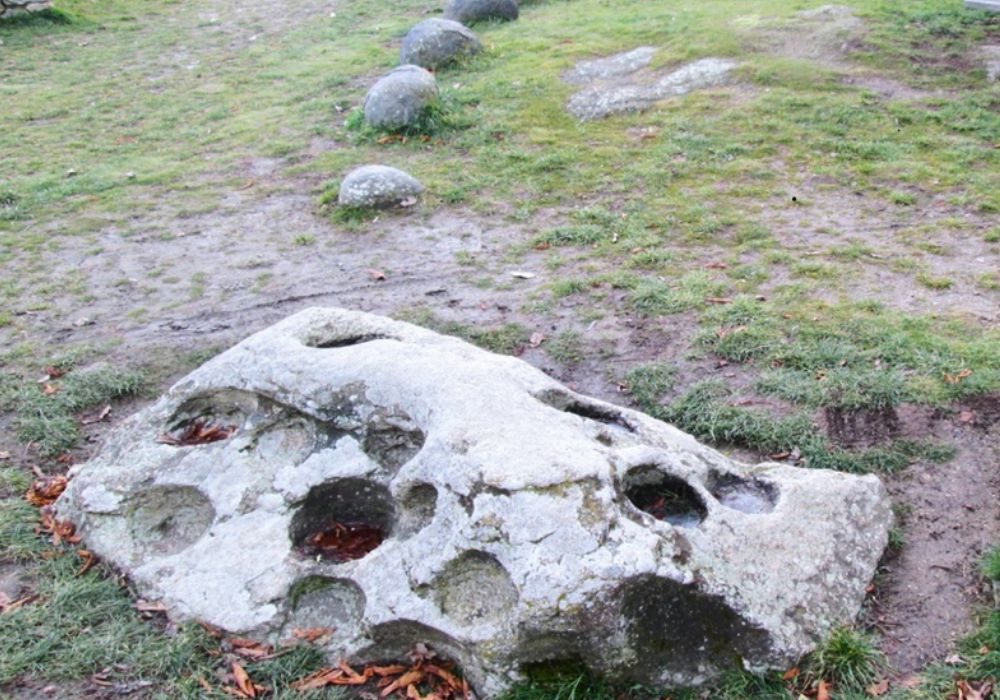
is based on the assumption that the (researched and) found directions originating in the archaeological site are intentionally oriented (aligned) to the astronomical target; therefore, it is unlikely that the direction will be chosen randomly. The fundamental elements include the astronomical azimuth and the height of Sun and Moon above the horizon in the marginal seasons, i.e., during the winter and summer solstice, equinox, in Moon also focuses on the high and low lunar standstill (Mat 2017). Aveni (2019), in this context, points out Thom’s postulate as he had called it. Citation: ‘The procedure for tapping into the Thom paradigm went like this. First look for the solstices and if you’re successful, then seek out the lunar standstills’. So far, the cup-marked stones have not been researched similarly, even as part of megaliths. The author of the thesis assumed that the cup-marked stones as a part of the landscape were created at least concerning geographical directions and then perhaps also to astronomical targets. When he found out that, in addition to the basic topographic directions, the numbers of holes on the stones are also significant and their mutual position as a possible representation of the Moon cycle is important, he followed this direction. Eventually, the position of the rising Moon after dark and its luminosity during the entire lunar cycle became decisive for the analysis.
Methodology
The importance of moonlight has been critical in the entire history of humanity in the northern hemisphere (also even today, for example, for hunters), especially in the winter months (November–December–January). At that time, nautical twilight (as practical darkness) according to the(Meteogram, “Nautical twilight”) comes around 5 pm and the moonrise is thus symbolically determined by the oncoming twilight. Darkness represents 2/3 of the whole day; dawn comes around 7 am. In addition to this practical aspect, the changing moonlight stood at the centre of the mythologies of all cultures, and its symbol was also reflected in the layout of the cup-marked stones. Due to the difficulty of understanding the lunar cycle and processing it further, the author chose the following forms of simplification and modelling.
The modelling of the draconian moon cycle (28-day interval) aims to capture the dynamics of Moon changes in a reduced graphic form with its evening/night positions at dawns according to the topographic azimuth. The models contain except basic cardinal directions of north N 0°– (360°), east E 90°, south S 180°, west W 270°, the other positions only in degrees.
Moon phases in numerical model
The table is a numericalmodel of the lunar cycle. It contains data taken from Moonrise and Moonset Calculator for Znojmo for lunar cycle 11/12/2022 and is standard for all theoretical/practical models of the M. cycle.
Moon phases in theoretical model
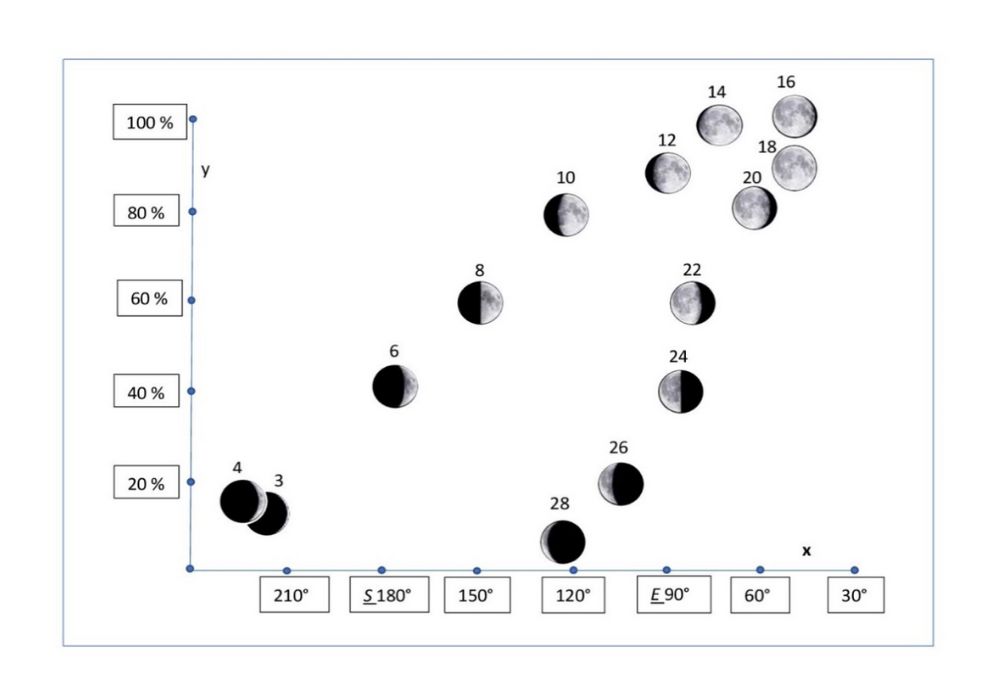
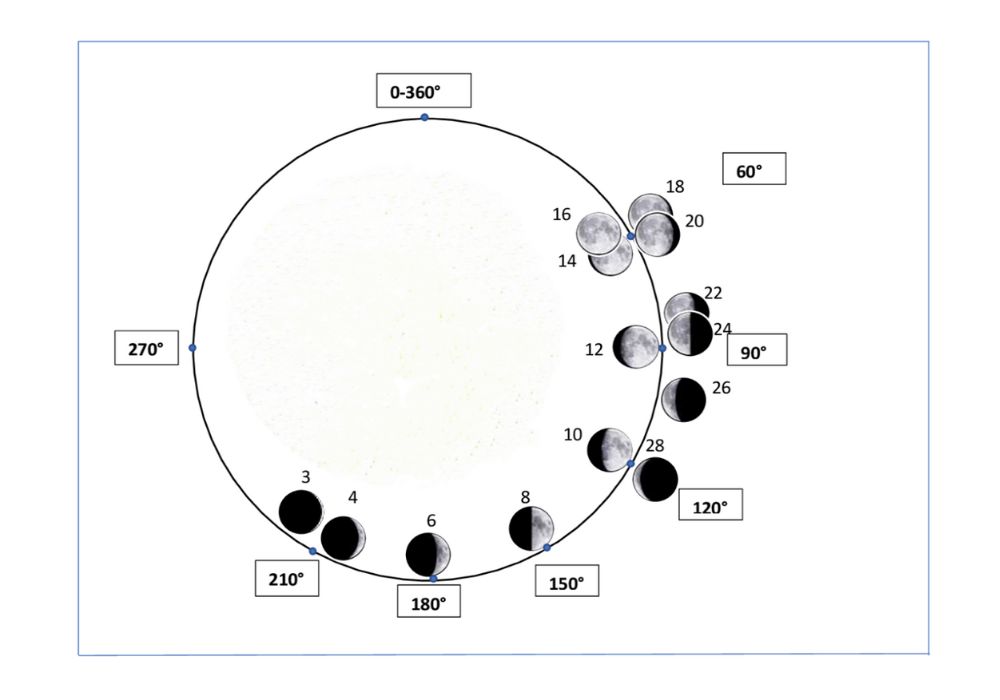
As a graph which contains 28-day Moon cycle in 2-day intervals with azimuth on the x-axis in °(degrees) corresponding to the directions of expected occurrence (dawn) of Moon. Ad hoc evening, winter sky in model was chosen as of 11/12/2022 for the period from 5 pm to 7 am. Data were obtained for 3–16 nights after the onset of nautical twilight from an open-source computer planetarium (Stellarium v0.20.4) (in tab. column e), astronomical dawns for 18–28 nights from the tables (Time and Date, “Moonrise and Moonset Calculator”)for Znojmo 48°51‘20‘‘N 16°2‘56‘‘E (in tab. column d). The lunar phases are marked by the numerical order of nights (in the table column b) and their position on the y-axis represents the illuminated area of Moon from 0 to 100% in the table column h. For a better idea, the icons of the individual phases of the M. cycle were used (column m in the table). In addition to the linear design, it has been proved that the circular model with the display of Moon icons better illustrates the topology of the dawns and makes the idea of the Moon cycle much easier.
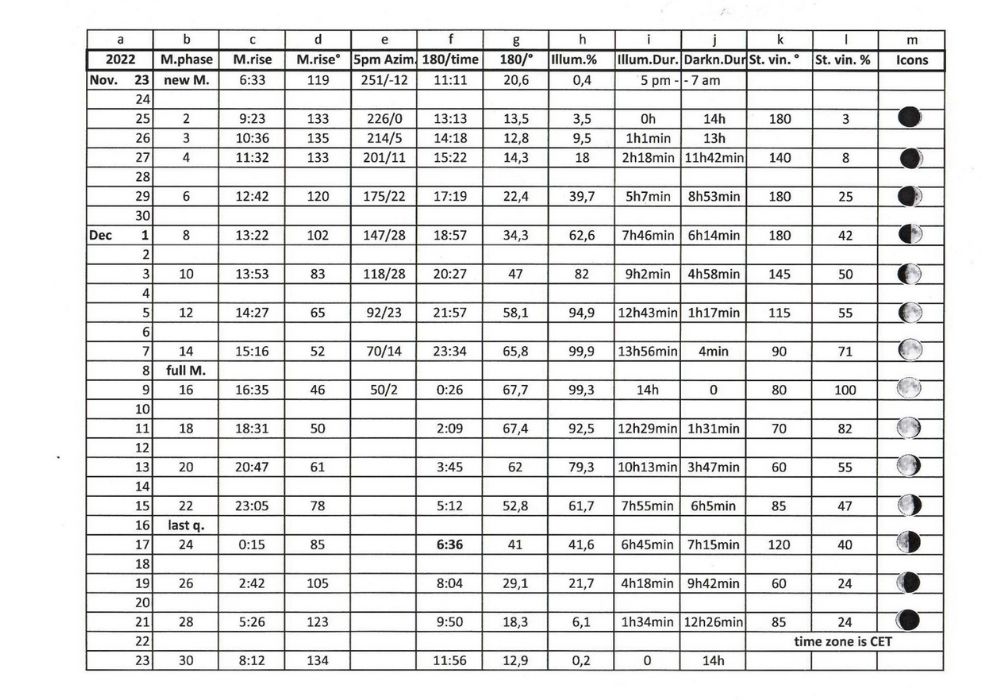
a date of the selected month b (M.phase) number of nights from 30-night M. cycle, c (M.rise) time of rising M. (table value), d (M.rise °) azimuth of the rising M. (table value, in degrees), e (5pmAzim) azimuth of the M. position at 5 pm (at the onset of nautical twilight) obtained using Stellaria, in the slash the height above the horizon is expressed in degrees, f (180/time) time of M. culmination over the southern horizon, g (180/°) culmination of M. in degrees over the southern horizon, h (Illum. %) percentage of illuminated area M., i (Illum.Dur.) duration of moonlight at night from 5 pm to 7 am, j (Darkn.Dur.) duration of darkness at night from 5pm to 7am, k (St.vin.°) azimuth of rising M. for Staré vinice cups (ad hoc values), l (St. vin. %) ad hoc M. lighting values in % for cups, m (Icons) M. icons